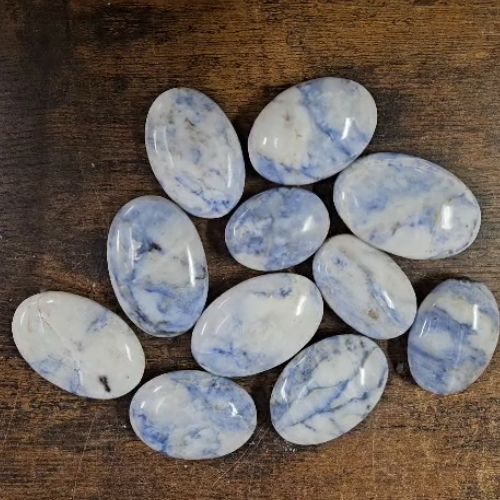
Afghanite Palm Stone 2"-3"
Share
SKU 71838
$11.99
In stock: 3 available
1
Delivery information
Pickup: today, 02:00 PM–08:00 PM
Product details
Afghanite Palm Stone 2"-3"
Mineral Information:
Afghanite is a rare royal blue mineral that shares mine space with lazurite in Afghanistan, it can be generally described as similar-looking to both Sodalite and Lapis while not quite being either, and is actually classed as part of the Cancrinite group. It's an aesthetically pleasing stone that is popular for ornamental use, but it occurs quite rarely in nature and is quite a bit harder to find than the similar-looking Lapis and Sodalite.
Afghanite is a rare mineral that was first discovered in 1968 in the Sar-e-Sang district of Afghanistan. It is a silicate mineral that typically forms in igneous rocks that have undergone hydrothermal alteration. Afghanite is known for its striking blue color and is often used as a gemstone or as a collector's specimen. It has a complex crystal structure that includes several different types of ions, including sodium, calcium, aluminum, sulfur, and chlorine. Afghanite has a hardness of 5.5 to 6 on the Mohs scale and is relatively brittle, meaning it can be easily broken or fractured if subjected to stress or impact.
Metaphysical Meaning:
Afghanite is said to have a stabilizing and calming force that promotes harmony and peaceful resolution of conflict. It is a stone that is believed to promote inner peace and tranquility. It is believed to enhance communication and self-expression. It balances the third eye and crown chakras and this helps to improve intuition and to think more clearly.
Mineral Care:
Afghanite is a relatively rare mineral that belongs to the cancrinite group. While it is not as well-known as some other minerals, it does possess certain characteristics that contribute to its fragility:
-
Crystal structure: Afghanite has a complex crystal structure composed of interconnected tetrahedrons of silicon, aluminum, and oxygen atoms. This arrangement creates a delicate lattice framework, which can be susceptible to breakage and damage when exposed to external forces.
-
Cleavage: Afghanite exhibits distinct cleavage planes, meaning that it has preferred directions along which it is more prone to splitting. If sufficient force is applied along these planes, the mineral can fracture or break apart easily.
-
Hardness: Afghanite has a relatively low hardness on the Mohs scale, typically ranging between 5 and 6. This means it is softer compared to many common minerals and is more prone to scratching or abrasion. The softness of the mineral makes it more susceptible to damage during handling or when in contact with harder materials.
-
Environmental factors: Environmental conditions can also impact the fragility of afghanite. Extreme temperatures, high humidity, and chemical exposure can cause the mineral to degrade or undergo chemical reactions, potentially leading to structural weakness or even disintegration.
Due to these factors, afghanite is considered a fragile mineral and requires careful handling and storage to minimize the risk of damage. It is often appreciated for its unique beauty and rarity, making its fragility a consideration for collectors and enthusiasts.
Disclaimer:
No information here is intended to diagnose, treat or cure ailments or afflictions of any kind. One should always consult a medical professional if a serious issue presents itself.
Afghanite Palm Stone 2"-3"
Share
Powered by Lightspeed
Display prices in:USD