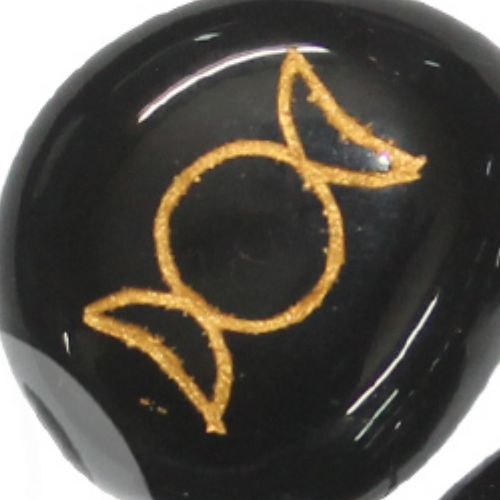
Agate Black Pocket Stone Charms w/ Pagan Symbols
Share
SKU 43859
$1.99
Type
Please choose
In stock: 23 available
1
Product details
Agate Black Pocket Stone Charms w/ Pagan Symbols
Includes Triple Moon Goddess, God, Spiral, Triskelion, Pentagram and Ankh symbols on small black agate pocket stones.
Dark, polished, and quietly powerful, Black Agate carries the beauty of midnight stone and the symbolism of unwavering ground beneath your feet. Traditionally associated with protection, stability, and inner strength, it is a stone for holding your center when the world around you feels uncertain.
Its darkness is not empty—it is layered. Subtle bands and shadowed patterns speak to agate's slow formation, creating a stone that feels ancient, composed, and enduring. Keep Black Agate close as a symbol of firm boundaries, steady courage, and the strength to remain rooted through change.
Ground. Protect. Endure.
Mineral Information:
Mineralogically, agate is a variety of chalcedony, which is itself a microcrystalline to cryptocrystalline form of silica, primarily silicon dioxide (SiO₂). Instead of forming the conspicuous individual crystals seen in a typical quartz cluster, chalcedony consists of extremely fine intergrowths of quartz and related silica structures. Agate is especially known for its banding, which develops as silica-rich fluids deposit successive microscopic layers within cavities and fractures in rocks. It has a Mohs hardness of roughly 6.5–7, making it durable enough for polished stones, carvings, beads, jewelry, and decorative objects.
Natural agate obtains its enormous range of colors from mineral impurities and microscopic inclusions incorporated during formation. Very dark gray, brown, and nearly black material can occur naturally, but an important distinction for retail purposes is that commercially sold “black agate” is sometimes color-enhanced or dyed. Agate's microscopic porosity makes some material particularly receptive to treatment, and darkening agate has a long history in the lapidary trade. Consequently, the exact identity and treatment status of a specimen should ideally come from a trustworthy supplier rather than being determined from color alone.
What makes black agate distinctive is the combination of agate's patterned, layered character with the visual symbolism of a black stone. Black obsidian tends to occupy the dramatic volcanic-glass niche, black tourmaline the strongly protective crystal niche, and hematite the metallic grounding niche. Black agate offers something aesthetically different: polished darkness that may contain subtle bands, translucent edges, gray transitions, or hidden internal patterns. Metaphysically, this lends itself particularly well to people who want a protective or grounding stone but prefer something quieter and more balanced in appearance and symbolism.
Black agate and other dark varieties of agate are found in a number of important agate-producing regions around the world, including Brazil, Uruguay, India, Mexico, Madagascar, Botswana, and the United States, particularly in areas with volcanic rocks where silica-rich fluids filled cavities and fractures. Brazil and Uruguay are especially important commercial sources of agate and supply large quantities of material to the lapidary industry, while India is both a source and a major center for cutting, polishing, and treating agate. However, intensely and uniformly black agate sold commercially may be dyed or otherwise treated agate rather than naturally black material, so a product's country of manufacture or export does not necessarily indicate where the original stone was mined.
Metaphysical Meaning:
Black agate has a particularly strong niche because its appearance naturally reinforces the qualities traditionally associated with it: grounding, protection, stability, self-control, and resilience. As a dark variety of agate, it is commonly presented as a stone for creating a sense of security and helping a person remain centered when circumstances feel chaotic or emotionally demanding. In crystal traditions, black stones are often associated with absorbing, deflecting, or shielding against unwanted influences, while agate more broadly has long-standing associations with balance and steadiness.
Black agate represents strength through stability rather than aggression. It is often used in practices concerned with grounding, boundaries, courage, emotional composure, and perseverance. Its energy is typically described as slow, steady, and reassuring rather than intensely stimulating. This makes it appealing for meditation, protective charms, altar arrangements, pocket stones, and practices intended to help someone feel anchored while dealing with uncertainty or change. Within chakra-based traditions, it is most commonly associated with the Root Chakra, reflecting themes of security, physical presence, belonging, and connection with the earth.
Its niche is therefore one of quiet fortification. Black agate works especially well as a stone representing boundaries, patience, stability, and enduring strength—the idea of remaining firmly rooted rather than overpowering whatever is happening around you. Its durability also makes it practical for objects intended to be carried or handled regularly, including worry stones, palm stones, bracelets, pendants, spheres, and small carvings.
Mineral Care:
Black agate is relatively durable, with a Mohs hardness of about 6.5–7, but it should still be protected from hard impacts, scratches, and prolonged exposure to harsh chemicals. Clean it gently with lukewarm water, mild soap, and a soft cloth or soft-bristled brush, then rinse and dry thoroughly. Avoid bleach, strong household cleaners, acids, and extreme or sudden temperature changes, and do not rely on ultrasonic or steam cleaning when the stone's treatment history is unknown. Because some commercially available black agate may be dyed or otherwise color-enhanced, prolonged soaking and repeated exposure to strong sunlight are best avoided, as these could potentially affect treated material. Store black agate separately from softer stones to prevent scratching them, and preferably in a soft pouch or lined compartment when it is not being used.
Disclaimer:
No information here is intended to diagnose, treat or cure ailments or afflictions of any kind. One should always consult a medical professional if a serious issue presents itself.
Agate Black Pocket Stone Charms w/ Pagan Symbols
Share
Powered by Lightspeed
Display prices in:USD