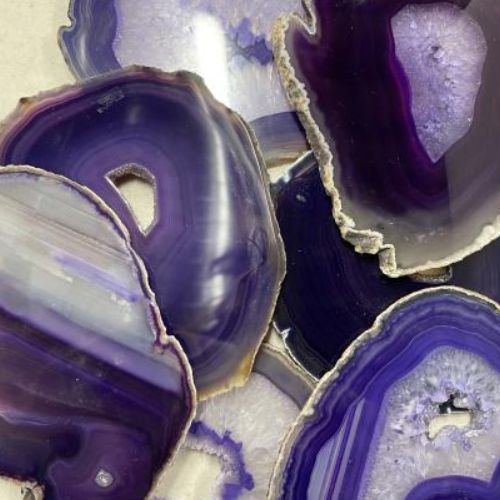
Agate Dyed Slice Purple 4"
Share
SKU 47920
$6.95
In stock: 1 available
1
Product details
Agate Dyed Slice Purple 4"
Color awakened in stone. Dyed Agate transforms the ancient bands of natural agate into brilliant landscapes of color, revealing hidden layers in vivid blues, radiant purples, lush greens, fiery reds, and dreamlike pinks. Beneath every enhanced hue lies genuine agate—formed layer by layer within the Earth and transformed through human artistry into something bold and expressive. Symbolizing grounding, balance, creativity, and personal transformation, Dyed Agate is a celebration of becoming: ancient stone, reimagined in color.
Mineral Information:
Mineralogically, agate is a variety of chalcedony, a cryptocrystalline form of silica composed predominantly of extremely fine intergrowths of quartz and moganite. It typically forms when silica-rich fluids repeatedly deposit material within cavities, fractures, or vesicles in host rock. These successive periods of deposition can create agate's characteristic bands, translucent layers, fortification patterns, plumes, clouds, and other structures. Agate has a Mohs hardness of roughly 6.5–7, making it durable enough for polished stones, carvings, jewelry, beads, and decorative objects.
Dyed agate differs from naturally colored agate primarily in how its visible color was produced. Agate contains microscopic pores and structural variations that can allow coloring agents to penetrate portions of the chalcedony. Different layers may absorb dye differently, which can actually make previously subtle banding dramatically visible. The resulting electric blues, intense magentas, emerald greens, purples, and other saturated colors may therefore be artificial, but the bands, crystalline structure, translucency, cavities, and geological patterns underneath them remain natural features of the agate. This distinction is important when labeling specimens: "dyed agate" communicates that the mineral itself is genuine while its coloration has been enhanced or altered.
The particular niche of dyed agate is its combination of accessibility, intense color, natural pattern, and decorative versatility. Natural agates certainly occur in beautiful colors, but treatment allows colors rarely encountered at such saturation in nature to be produced consistently. It can turn otherwise pale or visually understated agate into an exceptionally striking display piece while emphasizing intricate bands that might have been difficult to see beforehand. This makes dyed agate particularly popular for slices, bookends, coasters, pendants, carvings, geode displays, and brightly colored collections.
Within a magic store, dyed agate can consequently occupy a somewhat different niche from rare natural-color specimens. It does not need to compete with them on geological rarity. Instead, its strength is visual expression. It is a stone for people drawn first to color—someone who wants brilliant turquoise blue, luminous violet, hot pink, or saturated green can choose the appearance that resonates with them while still receiving an object made from genuine agate. Clear disclosure that the stone has been dyed makes that distinction a strength rather than a drawback.
The natural agate used for dyeing can originate from major agate-producing regions around the world, including Brazil, Uruguay, Mexico, India, Madagascar, Botswana, and the United States, among others. Brazil is especially important in the commercial agate industry, with large quantities of agate—particularly material from southern Brazil—being cut, polished, and sometimes artificially colored for decorative objects, jewelry, slices, and metaphysical products. The dyeing process generally takes place after the rough agate has been mined and processed, so a specimen sold simply as "dyed agate" cannot reliably be assigned a geographic origin based on its artificial color alone.
Metaphysical Meaning:
Dyed agate occupies an interesting place because it combines a natural stone with deliberate human transformation. The underlying material is genuine agate, while its unusually vivid blue, purple, pink, green, red, or other coloration may have been introduced or intensified through dyeing. In crystal traditions, agate generally represents stability, grounding, balance, protection, and emotional steadiness. Dyed agate is often marketed with those traditional associations intact, while its added color gives the stone another symbolic dimension. Blue pieces may be associated with tranquility and communication, green with growth and renewal, purple with intuition or spirituality, and pink with affection and emotional warmth.
There is also a compelling symbolic interpretation unique to dyed stones: transformation without losing one's foundation. The agate remains agate even though its outward appearance has been dramatically changed. For that reason, dyed agate can represent reinvention, creativity, self-expression, adaptability, and consciously choosing how one presents oneself to the world. Rather than pretending the treatment does not exist, a magic store can make the treatment part of the stone's story—the meeting of something formed by nature with something intentionally altered by human creativity.
Mineral Care:
Dyed agate is relatively durable, with the underlying agate measuring about 6.5–7 on the Mohs hardness scale, but extra care should be taken to preserve its enhanced coloration. Clean it gently with lukewarm water, mild soap, and a soft cloth, avoiding harsh chemical cleaners, bleach, acids, abrasives, ultrasonic cleaners, and prolonged soaking. Because some dyes may fade or change with extended exposure to strong sunlight or heat, store dyed agate away from direct sunlight when it is not on display. Avoid exposing it to perfumes, cosmetics, household chemicals, and extreme temperature changes. For metaphysical cleansing, gentler dry methods such as sound, smoke, moonlight, or placing the stone near quartz are preferable when the stability of the particular dye is unknown.
Disclaimer:
No information here is intended to diagnose, treat or cure ailments or afflictions of any kind. One should always consult a medical professional if a serious issue presents itself.
Agate Dyed Slice Purple 4"
Share
Powered by Lightspeed
Display prices in:USD