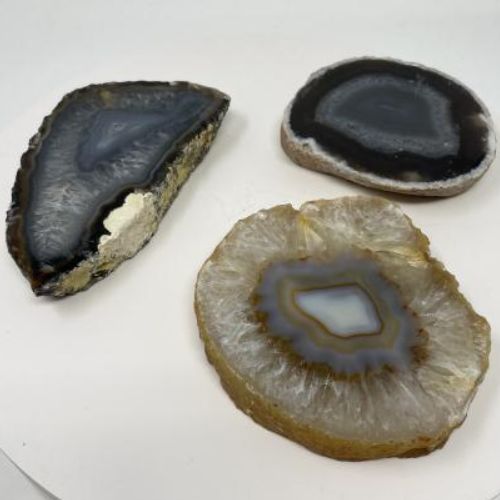
Agate Slab Extra Thick
Share
SKU 49581
$9.95
In stock: 1 available
1
Delivery information
Pickup: today, 12:00 PM–08:00 PM
Product details
Agate slabs of assorted sizes, ranging from 5" to 8".
Layered by the Earth, Steady in Spirit. Agate carries the beauty of time made visible—bands, clouds, colors, and patterns slowly written into stone. Traditionally treasured as a symbol of grounding, balance, protection, and quiet strength, each piece feels like a small record of the Earth’s patient artistry. No two agates tell quite the same story: some ripple with delicate bands, others bloom with crystalline pockets or reveal landscapes hidden within polished stone. For the collector, the seeker, or anyone drawn to nature’s intricate designs, Agate offers a timeless reminder that strength does not always arrive like a storm—sometimes, it is built one layer at a time.
Mineral Information:
Mineralogically, agate is a variety of chalcedony, which is a microcrystalline to cryptocrystalline form of quartz composed primarily of silicon dioxide (SiO₂). Instead of forming the large, easily visible crystals characteristic of clear quartz or amethyst, chalcedony consists of extremely fine intergrowths of silica minerals. Agate is especially distinguished by its patterns, most famously its bands. These can form as silica-rich fluids repeatedly deposit material within cavities and fractures in volcanic or other rocks. Variations in impurities, mineral inclusions, crystallization conditions, and successive stages of deposition can produce concentric rings, fortification patterns, clouds, plumes, eyes, and intricate layers.
Agate generally has a Mohs hardness around 6.5–7, making it durable enough for polished stones, jewelry, carvings, spheres, towers, and other decorative objects. Pure chalcedony can be relatively pale, while iron oxides and other mineral inclusions can introduce reds, browns, yellows, blacks, greens, and additional colors. Agate's porosity can also allow some specimens to accept dyes readily, which is why vividly colored commercial agates may be artificially enhanced. The enormous variety of internal structures is responsible for names such as Crazy Lace Agate, Dendritic Agate, Blue Lace Agate, Botswana Agate, and numerous locality- or pattern-based trade names.
Agate's particular niche is its extraordinary combination of geological variety and accessibility. Two pieces can belong to the same broad mineral family yet look almost unrelated: one may contain delicate parallel bands, another resemble a landscape, and another contain branching dendrites or sparkling druzy cavities. This makes agate almost a collecting category unto itself. It can appeal to someone interested in geology, lapidary work, metaphysical symbolism, natural patterns, or simply beautiful objects. Unlike some gemstones whose appeal revolves primarily around clarity, rarity, or a single prized color, agate celebrates pattern, individuality, and structure.
Agate occurs in many parts of the world and is particularly associated with regions that have extensive volcanic rocks in which silica-rich fluids could fill cavities and fractures. Important commercial sources include Brazil, Uruguay, Mexico, India, Madagascar, Botswana, Argentina, and the United States, among many others. Individual localities can produce agates with distinctive colors and patterns, leading to numerous geographic and trade names; Botswana Agate, for example, is famous for finely layered banding, while parts of Brazil and Uruguay are major sources of agate geodes and banded material used for cutting and polishing. Agate is also found throughout several regions of the United States, including areas around the Great Lakes and western states. Because it forms under many geological conditions and occurs worldwide, agate's locality is often an important part of a specimen's identity and collectibility.
Metaphysical Meaning:
Agate is traditionally regarded as a stone of grounding, stability, balance, and steady strength. Rather than being associated with sudden transformation or intense bursts of energy, agate occupies a quieter niche: it represents endurance, emotional composure, patience, and the ability to remain centered while circumstances change. In crystal traditions, it is often used when someone wants to feel more secure, establish a stable foundation, or bring conflicting thoughts and emotions into greater harmony. Its naturally layered appearance reinforces this symbolism—many individual bands coming together to form a unified stone.
Agate is also commonly associated with protection and strengthening. Historically, varieties of agate have been fashioned into amulets, seals, beads, carvings, and ornamental objects, helping give the stone a long-standing place in both decorative and symbolic traditions. Modern metaphysical practice often interprets agate as supportive rather than forceful: a stone for gradually building confidence, resilience, concentration, and emotional equilibrium. Different varieties add their own symbolic character—Blue Lace Agate is associated with calm communication, Moss Agate with growth and nature, and Black Agate with grounding—but the broader agate family tends to retain themes of stability and balance.
Within a metaphysical collection, this variety also gives agate an unusually broad role. Agate can function as a foundational stone for grounding and balance while its individual varieties provide more specialized symbolism. This makes it particularly well suited for a variety of people. There is an agate for people attracted to soothing pastels, dramatic blacks, fiery reds, earthy landscapes, botanical patterns, sparkling druzy surfaces, or intricate bands. Agate bridges the worlds of mineral specimen, gemstone, talisman, decorative object, and collectible, giving it a niche that few other stone families can match.
Mineral Care:
Agate is a relatively durable stone, with a Mohs hardness of approximately 6.5–7, but it should still be treated with reasonable care to preserve its polish and color. Clean agate using lukewarm water, mild soap, and a soft cloth or soft-bristled brush, then rinse and dry it thoroughly. Avoid harsh chemical cleaners, bleach, strong acids, and prolonged exposure to extreme heat or rapid temperature changes. Although natural agate is generally stable, dyed or otherwise treated agate deserves additional care, as extended exposure to strong sunlight, chemicals, or soaking may cause some enhanced colors to fade or change. Store polished pieces separately from softer minerals to prevent scratching them, while keeping agate away from harder materials such as diamond or corundum that could scratch its surface.
Disclaimer:
No information here is intended to diagnose, treat or cure ailments or afflictions of any kind. One should always consult a medical professional if a serious issue presents itself.
Agate Slab Extra Thick
Share
Powered by Lightspeed
Display prices in:USD