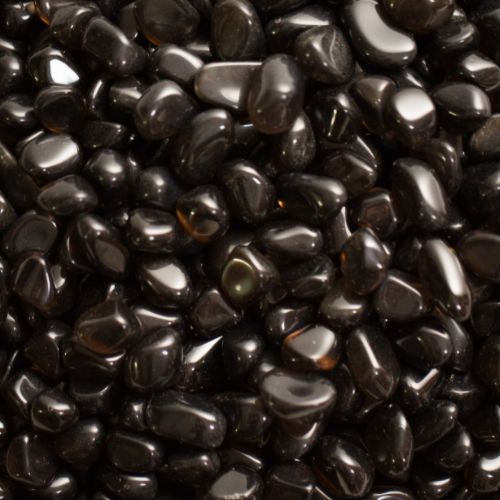
Apache Tear Tumbled Stone .5"-.75"
Share
SKU 41129
$1.29
In stock: 102 available
1
Product details
Apache Tear Tumbled Stone .5"-.75"
LOCATION Arizona
Mineral Information:
Apache Tears are small, dark-colored stones that are often used in spiritual and healing practices. They are a type of obsidian, which is a volcanic glass formed from rapidly cooling lava.
Apache Tears are named after a legend of the Apache tribe, which tells of a group of Apache warriors who were surrounded by U.S. cavalry troops on a cliff overlooking the Superior Valley in Arizona. Rather than surrender, the warriors chose to ride their horses off the cliff to their deaths. The story goes that their women and children cried tears of grief, which turned into stone upon hitting the ground, creating the first Apache Tears.
Apache Tears are typically small and oval-shaped, with a smooth, polished surface. They range in color from black to dark brown, and may have translucent or opaque areas. They are often used in spiritual and healing practices, and are believed to have a number of metaphysical properties, including:
Metaphysical Meaning:
Apache Tears are said to help with grounding and stabilizing energy, making them useful for those who are feeling scattered or unbalanced. Apache Tears are also good for protection and spiritual development. Apache Tears help to ward off negative energies.
Mineral Care:
Apache tear is a type of obsidian, which is a volcanic glass. While obsidian in general is known for its hardness, apache tear has unique characteristics that make it relatively fragile. Here's an explanation of its fragility:
-
Structure: Apache tear is formed by the rapid cooling of lava, which results in the formation of volcanic glass. Unlike minerals with a crystalline structure, volcanic glass lacks a regular arrangement of atoms. This lack of a crystal structure contributes to its relatively low toughness and overall fragility.
-
Lack of Cleavage: Unlike minerals with well-defined cleavage planes, apache tear lacks cleavage. Cleavage refers to the tendency of a mineral to break along specific planes, resulting in smooth, flat surfaces. Apache tear, being a glassy material, lacks such planes of weakness. Instead, it tends to fracture irregularly when subjected to stress.
-
Conchoidal Fracture: Apache tear exhibits conchoidal fracture, similar to other types of glass and obsidian. This type of fracture produces curved, shell-like surfaces when the material breaks. While conchoidal fracture can create aesthetically pleasing patterns, it also indicates a tendency for the material to break into sharp, irregular pieces.
-
Hardness and Brittleness: Apache tear has a hardness of around 5 to 5.5 on the Mohs scale, which is relatively moderate. While it is harder than some minerals, it is still less resistant to scratching and impact compared to harder materials. Combined with its brittle nature, this makes apache tear more susceptible to breakage when exposed to stress or impact.
-
Sensitivity to Temperature and Chemicals: Apache tear can be sensitive to extreme temperature changes and some chemicals. Rapid or drastic temperature changes can cause thermal stress, leading to fractures or even shattering. Additionally, certain chemicals can react with the glassy structure of apache tear, potentially causing it to weaken or deteriorate.
Given the fragility of apache tear, it is important to handle it with care to minimize the risk of breakage. Avoid subjecting it to rough handling, excessive pressure, or sudden temperature changes. When storing or transporting apache tear, it is advisable to provide cushioning or protection to prevent impacts that could lead to damage.
Disclaimer:
No information here is intended to diagnose, treat or cure ailments or afflictions of any kind. One should always consult a medical professional if a serious issue presents itself.
Apache Tear Tumbled Stone .5"-.75"
Share
Powered by Lightspeed
Display prices in:USD