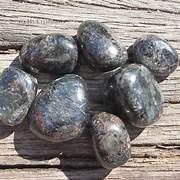
Astrophyllite Tumbled Stone Grade A .75"-1"
Share
SKU 30606
$7.99
In stock: 13 available
1
Product details
Astrophyllite Tumbled Stone Grade A .75"-1"
Mineral Information:
Astrophyllite is a rare and unique mineral that belongs to the group of complex silicates. It is known for its beautiful radiating star-like patterns, which give it its name, derived from the Greek words "astron" meaning star and "phyllon" meaning leaf. Astrophyllite is chemically classified as a potassium iron titanium silicate and has the chemical formula (K,Na)3(Fe,Mn)7Ti2Si8O24(O,OH)7.
Astrophyllite typically occurs in brown to bronze colors, although it can also exhibit shades of golden yellow and reddish-brown. It has a metallic to pearly luster and can have a submetallic sheen. Its crystal structure forms in tabular or bladed crystals, often with a radiating or star-like pattern due to its characteristic fibrous appearance.
This mineral is commonly found in association with alkaline igneous rocks, such as syenite and nepheline syenite. It is often found in Russia, Canada, Norway, and the United States.
Metaphysical Meaning:
Astrophyllite is said to be a stone that promotes spiritual connection, providing powerful growth and exploration to help one enhance one's intuition, insight, and spiritual awareness. It is known as a stone of transformation and helps to facilitate positive change and growth. It is also used to balance the aura, chakras, and energy field. Aligns with the solar plexus chakra.
Mineral Care:
Astrophyllite is a relatively delicate mineral compared to harder gemstones. Its fragility is influenced by a few factors:
-
Cleavage: Astrophyllite exhibits perfect cleavage along certain planes. Cleavage refers to the tendency of a mineral to break along specific planes of weakness. In the case of astrophyllite, if it is subjected to force or impact in the direction of its cleavage planes, it can break or fracture more easily.
-
Structure: Astrophyllite has a relatively thin, fibrous structure, which can make it more delicate compared to denser minerals. The thin layers of the mineral can be prone to splitting or breaking under stress or pressure.
-
Softness: Astrophyllite has a hardness of around 3.5 to 4.5 on the Mohs scale, which indicates that it is relatively soft. Being a softer mineral, it can be more susceptible to scratching, abrasion, and damage from harder materials.
To protect and care for astrophyllite, it is important to handle it with care and avoid exposing it to excessive force, impact, or abrasive materials. It is advisable to store astrophyllite in a secure place where it won't come into contact with other hard objects that could potentially scratch or damage it. When cleaning, it is recommended to use gentle methods, such as using a soft brush or cloth, and to avoid harsh chemicals or rough cleaning techniques that could harm the mineral's delicate structure.
By handling astrophyllite with care and taking necessary precautions, you can help preserve its delicate beauty and minimize the risk of damage or breakage.
Disclaimer:
No information here is intended to diagnose, treat or cure ailments or afflictions of any kind. One should always consult a medical professional if a serious issue presents itself.
Astrophyllite Tumbled Stone Grade A .75"-1"
Share
Powered by Lightspeed
Display prices in:USD