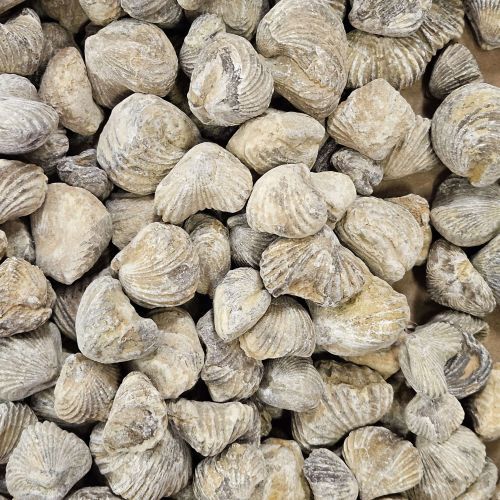
Brachiopod Fossil .5"-1"
Share
SKU 53274
$1.29
In stock: 215 available
1
Product details
Brachiopod Fossil .5"-1"
Fossil Information:
A brachiopod fossil is the preserved remains or traces of a brachiopod, which is a marine invertebrate animal. Brachiopods are members of the phylum Brachiopoda and are often referred to as "lampshells" due to their shell-like appearance. These organisms have been around for hundreds of millions of years and have a long fossil record that dates back to the early Cambrian period.
The characteristic feature of brachiopods is their double-shelled structure, with the shells known as valves. These valves are usually symmetrical, but the upper and lower valves can be of different shapes. Brachiopods are not closely related to bivalve mollusks, even though they share a superficial resemblance due to their shell structure.
The fossilized remains of brachiopods are found in various sedimentary rocks, and they are important for paleontologists and geologists in studying the history of life on Earth. Brachiopod fossils are often used as index fossils, helping to date the age of the rocks in which they are found. They are also valuable for understanding ancient marine ecosystems and environmental conditions.
Metaphysical Meaning:
Brachiopod fossils can have a variety of meanings depending on how an individual interprets their connection to the fossil. It could symbolize a connection to ancient energy, since the fossils are ancient. The fossils date hundreds of millions of years and some believe these fossils carry wisdom and energy from ancient times. Others interpret it as a stone of transformation, given that these organisms have evolved over millions of years.
In other uses, the fossil can be used for grounding and stability by helping people feel connected to the present moment.
Mineral Care:
Brachiopod fossils can be fragile due to several factors related to their composition and preservation. Here are some reasons why brachiopod fossils are often considered fragile:
Shell Composition: Brachiopods have shells composed of calcium carbonate, similar to many other marine organisms. Calcium carbonate can be susceptible to dissolution in acidic conditions or by the action of certain chemicals. Over time, this can weaken the structure of the shell and make it more fragile.
Fine Structure: The shells of brachiopods often have fine and intricate structures, with delicate features such as ribs, spines, or ornamentation. These details can be easily damaged during the fossilization process or through subsequent geological processes.
Sedimentation: The preservation of brachiopod fossils involves the rapid burial of the organisms by sediments, preventing scavenging and decomposition. However, if the sedimentation is too slow or if the sediments are not fine enough to encapsulate the delicate structures of the brachiopod, the fossils may be more prone to breakage.
Brittleness: Depending on the mineral composition of the fossilized shell, brachiopods can become brittle over time. Changes in environmental conditions, such as fluctuations in temperature and humidity, can contribute to the brittleness of the fossils, making them more prone to breakage.
Taphonomic Processes: Taphonomy refers to the various processes that affect the remains of an organism from the time of death to its eventual discovery as a fossil. Fossilization involves a series of complex processes, and if conditions are not ideal, the delicate structures of brachiopod shells may not be well-preserved.
Due to these factors, paleontologists often handle brachiopod fossils with care, and the delicate nature of these fossils makes them more challenging to extract and study compared to more robust fossils. Despite their fragility, well-preserved brachiopod fossils provide valuable insights into the ancient marine environments and the evolution of life on Earth.
Disclaimer:
No information here is intended to diagnose, treat or cure ailments or afflictions of any kind. One should always consult a medical professional if a serious issue presents itself.
Brachiopod Fossil .5"-1"
Share
Powered by Lightspeed
Display prices in:USD