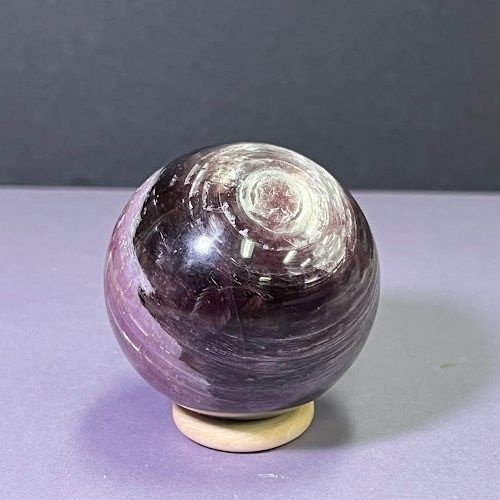
Lepidolite Gem Grade Sphere - Select
Share
SKU 61450
$97.99
Type
Please choose
In stock: 1 available
1
Delivery information
Pickup: tomorrow, 12:00 PM–08:00 PM
Product details
Lepidolite Gem Grade Sphere - Select
Lavender light captured in shimmering stone, Lepidolite invites the spirit to soften, breathe, and begin again. Its silvery-violet layers seem to hold the hush of twilight—a quiet sanctuary for reflection, release, and gentle transformation. Keep it near whenever life feels too loud, and let its serene beauty become a symbol of peace unfolding one delicate layer at a time.
Mineral Information:
Lepidolite is a lithium-rich member of the mica mineral group, admired for its soft lilac, lavender, rose-violet, and silvery-gray coloring. Like other micas, it forms in thin, flexible sheets and often displays a pearly or shimmering luster. It commonly develops in lithium-rich granite pegmatites alongside minerals such as quartz, feldspar, tourmaline, spodumene, and sometimes rubellite. Its delicate layers and muted purple tones give it an appearance that is both earthy and ethereal.
Mineralogically, lepidolite is especially notable as an important indicator of lithium-rich geological environments. The name is commonly used for lithium-bearing micas within the polylithionite–trilithionite series, rather than for one rigidly defined composition. Its violet coloration is generally associated with trace manganese, although specimens vary considerably in color and chemistry. Lepidolite is relatively soft—usually around 2.5 to 4 on the Mohs scale—and has perfect cleavage, meaning it separates easily along its thin layers. This makes it beautiful for display and carving but less durable than quartz-based stones.
What makes Lepidolite special is the harmony between its physical nature and its metaphysical identity. Its layered mica structure resembles delicate pages or petals, suggesting that personal change may happen gradually, one layer at a time. Its natural lithium content also gives the stone an intriguing mineralogical connection to an element widely known in modern technology and medicine, although possessing Lepidolite does not reproduce lithium’s pharmaceutical effects. Its niche lies somewhere between a soothing meditation stone, a symbol of emotional release, and a beautiful reminder that softness can itself be a form of resilience.
Metaphysical Meaning:
Lepidolite is best known as a stone of calm, emotional balance, and graceful transition. It is often associated with releasing accumulated stress, quieting repetitive thoughts, and creating a more peaceful inner atmosphere. Practitioners may keep it beside the bed, place it in meditation spaces, or carry it during periods of uncertainty and change. Lepidolite is one of the most recognizable stones for tranquility and emotional restoration.
Lepidolite is frequently connected with the heart, third-eye, and crown chakras. Its lavender color supports its symbolic association with reflection, intuition, spiritual awareness, and compassionate self-understanding. Unlike stones marketed primarily for ambition, protection, or outward power, Lepidolite occupies a gentler niche: it represents the strength found in pausing, accepting, and loosening one’s attachment to patterns that no longer serve. It is particularly suited to rituals involving rest, emotional renewal, life transitions, and the cultivation of a quieter mind.
Mineral Care:
Lepidolite is a soft, delicate mica—approximately 2.5 to 4 on the Mohs scale—with perfect cleavage, so protect it from scratches, impacts, pressure, and prolonged handling that may cause its layers to flake. Clean it gently with a soft, dry cloth or a slightly damp cloth when necessary, then dry it immediately; avoid soaking, saltwater, ultrasonic or steam cleaners, harsh chemicals, and abrasive brushes. Store it separately in a padded box or soft pouch, away from harder stones, excessive humidity, and prolonged direct sunlight, which may gradually fade its lavender color. For symbolic cleansing, gentle methods such as moonlight, sound, smoke, or placing it near—not directly against—a sturdy quartz specimen are safer than water or salt.
Disclaimer:
No information here is intended to diagnose, treat or cure ailments or afflictions of any kind. One should always consult a medical professional if a serious issue presents itself.
Lepidolite Gem Grade Sphere - Select
Share
Powered by Lightspeed
Display prices in:USD