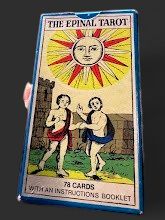
The Epinal Tarot Deck Tarot D'Epinal OOP 1979 Used Grimaud
SKU 80391
$60.00
On Sale
was $75.00 Save 20%
In stock: 1 available
1
Product Details
The Epinal Tarot Deck, Tarot D'Epinal, OOP 1979 Used copyright by J M Simon. Published by Grimaud in France. Deck & LWB is written in English and French. The box is in good condition with a little wear at the corners. The Cards are in excellent condition. The LWB seems intact but pages are not in the right order and it appears several pages are missing.
This deck is a bilingual French/English printing. The deck has 79 cards, the additional card is named 'the Consultant' and is a Significator card. The deck was a reprint of one from 1830 printed by Pellerin (France). The deck was based upon woodcuts designed by the engraver Georgin.
In most ways the Major arcana cards are traditional, but there are some with significant differences. For example, the name and image assigned to the numeral II are that of Juno, numeral V depicts Jupiter. The Empress and Emperor cards, are unnumbered. The name titles on some cards are not as expected either, the card we know as The Magician is 'Escamoteur', translated as 'The Conjurer'.
The card which to us is The Tower is named 'La Maison de Dieu', translated as 'The House of God'. The title provides a religious reference that in many modern decks is seldom seen.
The card attributed to the numeral IX, commonly named The Hermit, is in this deck referred to as ‘Le Capucin' and is translated to 'The Monk' - obviously not a literal translation. A more direct interpretation of the title would be 'The Capuchin Monk' or 'The Capuchin'; this too serves up a decidedly religious flavor along with the card message.
Oddly enough, the Death card bears no title. The heads, hand, foot and bone lying on the ground, sans bodies, provide an ideal level of shock value. The skeleton is guilty of the gruesome deed; he is still holding the scythe and is smiling.
'Le Fou' (The Fool), which is translated as 'The Madman' is an intriguing card. In ways it's as we'd expect, but the male figure has a look on his face that appears to be angst; the cat hitching a ride on his leg looks as if attacking him.
The use of Roman numerals on the Majors is atypical in usage at times; example: IX is VIIII, XIX is XVIIII.
The Minors are Marseilles-like pips. The Courts are also illustrated in a style like that of Marseilles decks.
The cardstock is sturdy; the finish appears to be a light laminate and is satiny, and ever so slightly grain-textured.
The card backs are interlocking curved lines in red and blue, reminiscent of the Marseilles style Sword images. The card back background is black with narrow white borders. This design is accented with flowers of red and yellow in the corners, and a flower of red and green, which resembles a cross in the center.
The box is blue on the top and sides and shows a picture of The Sun card both front and back.
Save this product for later
The Epinal Tarot Deck Tarot D'Epinal OOP 1979 Used Grimaud
Powered by Lightspeed
Display prices in:USD