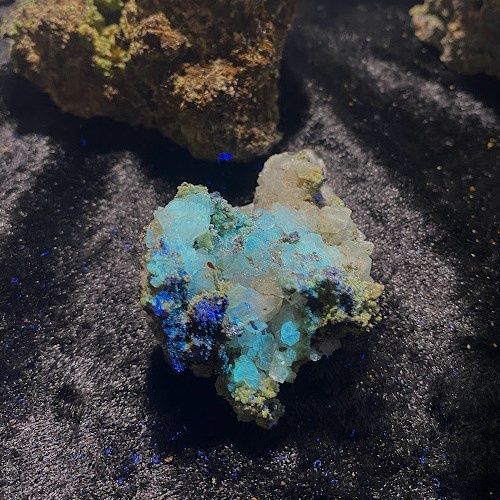
Wulfenite w/ Mimetite and/or Conichalcite Specimen Some UV Reactive - Select
Share
SKU 56475
$4.99
Sold out
Type
Please choose
Sold out
Product details
Wulfenite w/ Mimetite and/or Conichalcite Specimen Some UV Reactive - Select
Mineral Information:
Wulfenite with Mimetite and Conichalcite is a striking combination of three secondary minerals that often form together in the oxidized zones of lead and copper ore deposits. These specimens are prized because they combine bright colors and contrasting crystal habits in a single piece.
Wulfenite
Wulfenite is a lead molybdate (PbMoO₄).
- Usually forms thin square or rectangular tabular crystals.
- Most famous colors are orange, honey-yellow, reddish-orange, and golden-yellow.
- Has an exceptionally high luster that can appear almost glassy or resinous.
- Hardness: 2.5–3 on the Mohs scale.
On these specimens, the wulfenite is often the large, eye-catching crystal that forms the foundation.
Mimetite
Mimetite is a lead arsenate chloride (Pb₅(AsO₄)₃Cl).
- Commonly forms small hexagonal crystals, rounded clusters, or barrel-shaped crystals.
- Usually appears bright yellow, golden, orange-yellow, or greenish-yellow.
- Hardness: 3.5–4.
Because both wulfenite and mimetite contain lead, they commonly occur together in the same oxidized lead deposits.
Conichalcite
Conichalcite is a calcium copper arsenate hydroxide.
- Usually forms velvety, botryoidal (grape-like), or powdery coatings rather than large crystals.
- Its color ranges from bright apple green to emerald green.
- Hardness: 4–4.5.
The green conichalcite often grows as a coating around the orange wulfenite and yellow mimetite, producing dramatic color contrast.
Why they occur together
These minerals form as groundwater alters primary lead and copper ores near the Earth's surface.
- Lead contributes to the formation of wulfenite and mimetite.
- Copper contributes to conichalcite.
- The oxidation process creates conditions where all three minerals can crystallize in close association.
Many famous specimens come from arid mining districts where oxidation has occurred slowly over thousands or millions of years.
Appearance
A typical specimen might have:
- Large orange or amber square wulfenite crystals
- Bright yellow mimetite crystal clusters perched on the wulfenite
- Apple-green conichalcite coating the surrounding rock or filling spaces between the crystals
The combination of orange, yellow, and green makes these some of the most colorful collector specimens.
Metaphysical Meaning:
Wulfenite: Inspiration and Manifestation
Wulfenite is commonly associated with:
- Creativity and inspiration – encouraging new ideas and artistic expression.
- Manifestation – helping transform ideas into concrete actions.
- Confidence – supporting self-belief when pursuing ambitious goals.
- Mental clarity – helping organize thoughts and focus on long-term objectives.
It is often linked with the Solar Plexus Chakra, which is associated with willpower, motivation, and personal strength.
Mimetite: Joy and Curiosity
Mimetite is believed to promote:
- Optimism and enthusiasm
- A sense of adventure and curiosity
- Mental flexibility, making it easier to approach problems from new angles.
- Emotional resilience, helping release pessimism or fear of change.
Many practitioners associate it with both the Solar Plexus Chakra and the Sacral Chakra, emphasizing creativity and enjoyment of life.
Conichalcite: Healing and Growth
Conichalcite is traditionally connected with:
- Emotional healing
- Patience and steady personal growth
- Compassion and kindness
- A stronger connection with nature and the natural world
Its green color leads many crystal practitioners to associate it with the Heart Chakra, symbolizing balance, healing, and emotional openness.
Mineral Care:
Although mimetite and conichalcite both contain arsenic in their chemical structure, the arsenic is chemically bound within the mineral lattice. Simply displaying or gently handling a specimen poses very little risk. The main precaution is to avoid creating or inhaling mineral dust (for example, by cutting, grinding, or sanding the specimen), and it's good practice to wash your hands after handling any mineral collection.
Care
Because these minerals are relatively soft:
- Keep away from harder minerals such as quartz.
- Handle by the matrix rather than the crystals.
- Dust gently with a soft artist's brush or a bulb blower.
- Avoid acids and harsh cleaners.
- Store in a padded display box away from prolonged vibration.
Disclaimer:
No information here is intended to diagnose, treat or cure ailments or afflictions of any kind. One should always consult a medical professional if a serious issue presents itself.
Wulfenite w/ Mimetite and/or Conichalcite Specimen Some UV Reactive - Select
Share
Powered by Lightspeed
Display prices in:USD